
Alabama’s public oyster harvest closes at 2 p.m. Wednesday, November 18, 2026. The Alabama Department of Conservation and Natural Resources says the closure covers all public water bottoms and is intended to protect the remaining spawning population after another season of low oyster abundance.
For oyster catchers, that is the deadline to plan around—not an invitation to keep harvesting until sunset. The Marine Resources Division’s November 13 closure announcement specifies the 2 p.m. cutoff. Its stated scope is public water bottoms; the notice should not be read as a blanket shutdown of every oyster farm or seafood business in Alabama.
The public reefs opened November 2. ADCNR anticipates a commercial harvest of fewer than 400 sacks this season, compared with nearly 25,000 sacks in 2024 and 5,000 in 2025. The current figure is an agency projection, not a final harvest total. Those numbers describe a shrinking opportunity for the people who work the reefs, as well as a problem for the resource itself.
Before the opening, Marine Resources Division surveys found low densities of legal-size oysters at Heron Bay, Cedar Point West and Cedar Point East. The agency also reported declines among very young and sub-adult oysters. Protecting what remains matters because the next harvest depends on more than the oysters already large enough to take.
ADCNR identifies unfavorable water conditions—including periods of low or high salinity and low dissolved oxygen—as pressures on spawning, survival and growth. Marine Resources Division Director Kevin Anson said oysters need at least 18 months to reach harvestable size and that an extended period of suitable water quality is needed for the reefs to recover enough to support stronger harvests. The announcement does not promise a recovery date or a reopening date.
Restoration work continues alongside the closure. Marine Resources Division staff and Auburn University researchers are assessing where oyster larvae settle and how water quality changes through the seasons in Mobile Bay and Mississippi Sound. The aim is to identify the most suitable areas for reef restoration. ADCNR says the work is funded through a $10 million Natural Resources Damage Assessment award using Deepwater Horizon oil-spill settlement funds.
The immediate instruction remains straightforward: public-bottom oyster harvesting ends at the announced cutoff. For any later trip, check current Marine Resources Division notices rather than treating this year’s opening dates as permission to harvest after the closure.
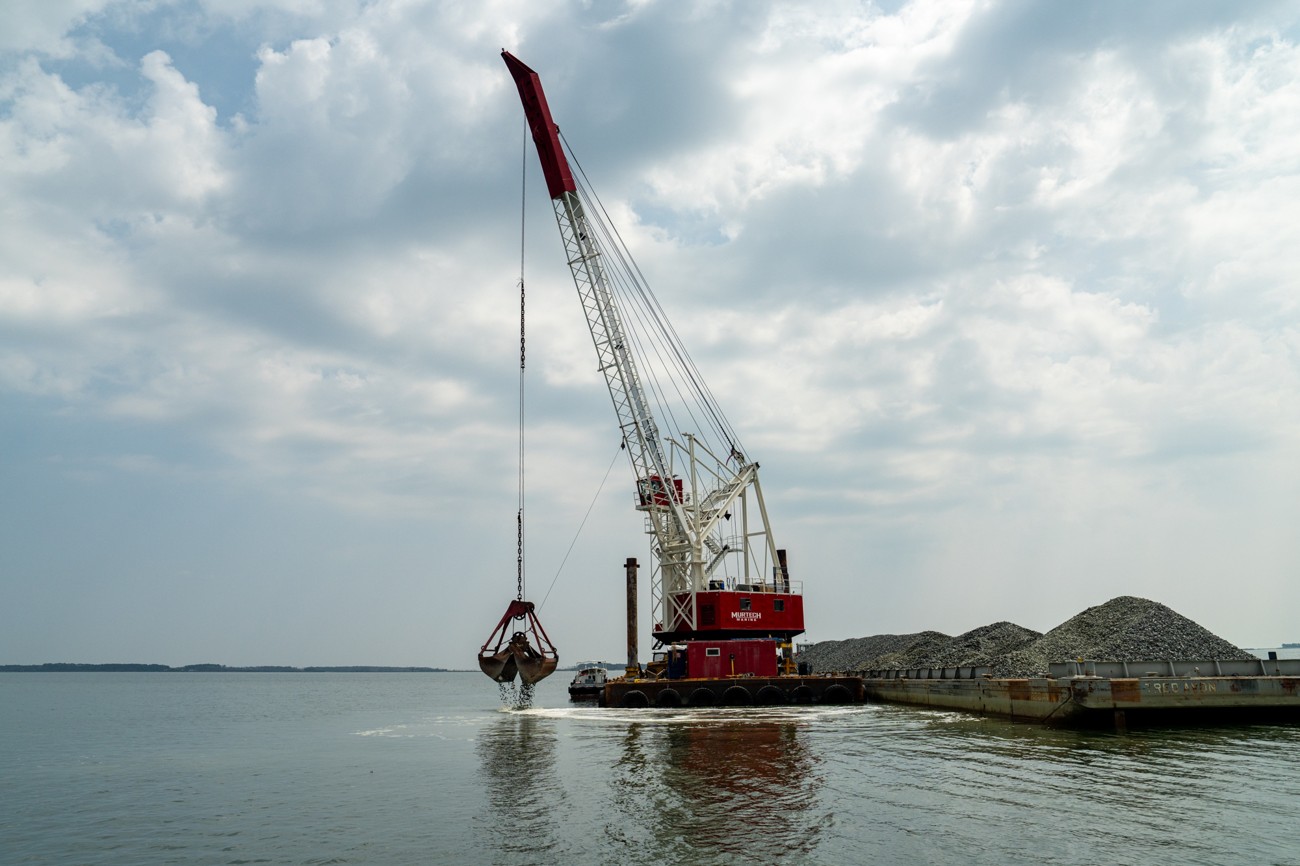
Illustrative file photo: a crane deposits stone to build an oyster reef at Hooper Strait Oyster Sanctuary, not an Alabama harvest or restoration site. Photo: Molly Feltner / NOAA. Courtesy: National Oceanic and Atmospheric Administration. The photograph appears on NOAA Fisheries’ Eastern oyster page.
Source & further reading
Alabama Department of Conservation and Natural ResourcesRegulations and conditions change. Check current official guidance before you hunt, dive or travel.
As an Amazon Associate I earn from qualifying purchases.