
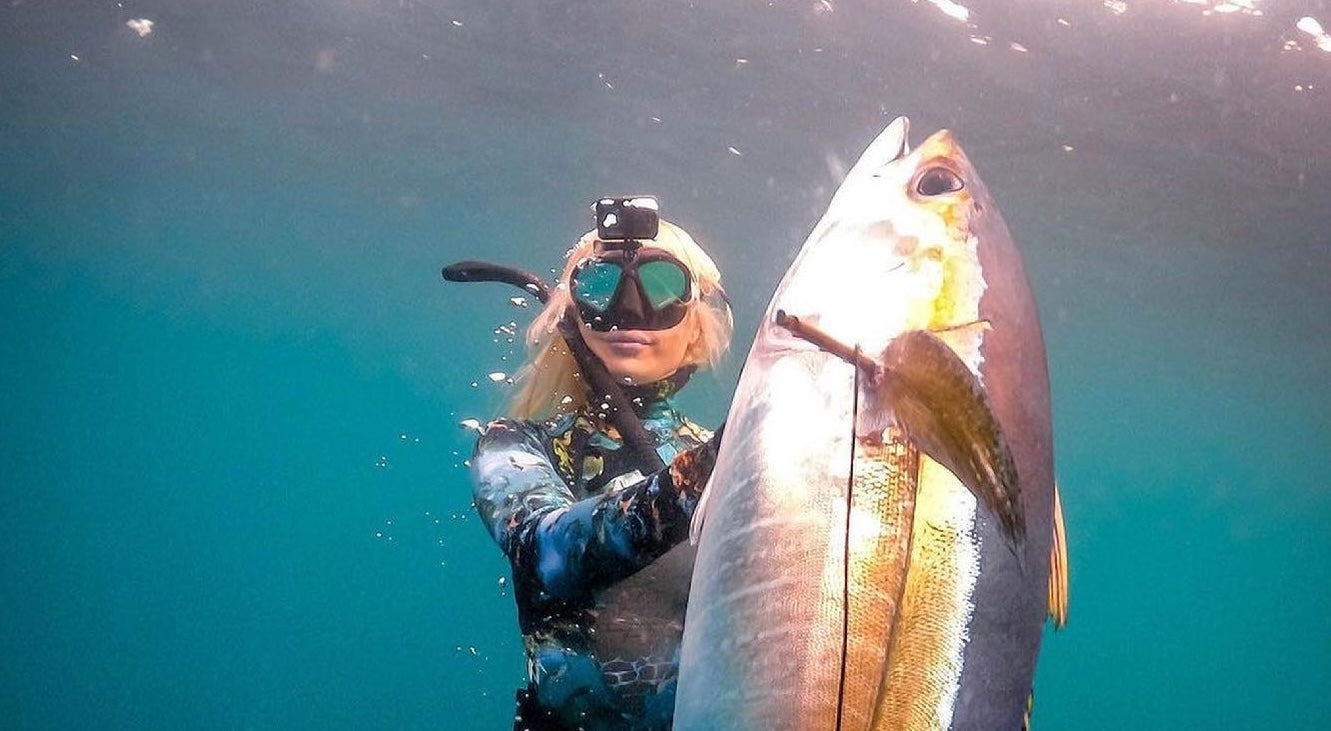
Bluewater spearfishing for tuna, wahoo and other pelagic fish takes more than a powerful gun. You're hunting in open water around current, boat traffic and fish that can put a serious load on a rig. Choose equipment as a complete system, and learn to use it with an experienced crew.
If you don't have a dive shop nearby, we've compiled a Bluewater Spearfishing Equipment List.
1. Speargun
Choose a gun with the range and penetration suited to the fish, and stay within the distances where you've proven your accuracy. Guns of 110 cm and longer are common starting points for this discussion, not a universal minimum. Railguns, other band guns and pneumatic designs have different handling characteristics.
Large fish require a properly matched retrieval system. Don't assume a reel is interchangeable with a bluewater float or breakaway rig; get help matching the entire setup to the target species.
2. Wetsuit and camouflage
Match insulation to water temperature, dive duration and your own cold tolerance. A 1.5–3 mm suit may suit warm-water trips, but bluewater isn't always warm. An open-ocean pattern may break up your outline; fit and warmth matter more than camouflage.
3. Fins
Long freediving fins can make swimming more efficient. Carbon fiber and fiberglass are common options, but blade stiffness should match your strength and technique. Stiffer isn't automatically better, and no fins make chasing tuna a sensible plan.
4. Dive computer
A freediving computer helps track depth and dive time. It is useful information, not protection from blackout. Training, conservative decisions and an attentive buddy remain essential.
5. Float and dive flag
A visible float and the locally required dive flag help alert boats to divers. Use a floatline system matched to the fish and conditions, and learn its release and entanglement hazards. Don't attach a fighting-fish system to your weight belt or otherwise tether yourself to a fish.
6. Dive knife
Carry an accessible, sharp dive knife for cutting line in an entanglement and for dispatching a catch. Know where it is and how to reach it with the rest of your gear on.
7. Gloves and booties
Gloves offer protection from line cuts, sharp scales and other abrasions. Booties help with warmth and foot protection around rocks and reefs. Neither is a reason to handle loaded lines or touch coral carelessly.
8. Mask and snorkel
A low-volume mask needs less air to equalize. Choose one that seals well and gives you a useful field of view. A simple snorkel with a comfortable mouthpiece is usually a practical choice.
9. First aid and emergency equipment
Bring a marine-appropriate first aid kit and a communication and rescue plan. Consider a personal locator beacon for remote trips. A GPS can tell you where you are, but a navigation-only device cannot summon help.
10. Flashers or lures
Flashers and reflective lures can draw curious fish closer in open water. Manage their lines with the same care as the rest of the rig and keep watching for other marine life.
Good equipment helps, but it doesn't make bluewater safe by itself. Dive within your training, work with your buddy and boat crew, and leave a fish alone when the conditions or shot aren't right.
More perspectives →