
A squirrel hunt belongs on the calendar for its own sake. Not just as something to do before deer season, and not only as a first hunt for somebody else's kid. An unhurried morning in the timber, a few good stalks and meat for supper make a worthwhile day for an experienced hunter too.
It's easy to let hunting become a project that needs several days off, a long drive and a truck full of equipment. Keep those trips. But leave room for a hunt you can actually make on an ordinary morning. Where access and an open season line up, squirrels offer a reason to get back into the woods without waiting for the year's biggest opportunity.
Pick a workable patch of woods
Start with a place where squirrel hunting is specifically allowed. Check the current season, license, legal species, equipment restrictions and any property-specific rules. Public ownership doesn't mean every parcel permits every kind of hunting, and permission to deer hunt a farm doesn't automatically settle a different visit with a different plan.
Look at overlapping seasons as well. Confirm the hunter-orange requirements and any restrictions that apply while other hunts are underway. On private ground, tell the landowner when you intend to be there. On shared ground, choose a route with other users in mind rather than assuming a quiet parking lot means you have the woods to yourself.
Make the outing small enough to finish properly. Choose a manageable area, set a return time and leave room afterward for cleaning and cooling the harvest. A short hunt loses its convenience if the meat-care job collides with the rest of the day. You don't need to cover the whole property to learn something useful about one stand of trees.
Let the food tell you where to stop
The Missouri Department of Conservation's squirrel-hunting guidance describes fox squirrels using timber edges, open woods and isolated woodlots, while gray squirrels are more associated with extensive forest and bottomlands. It also notes that both can use the same area. Those are starting points for looking, not a guarantee about which squirrel will appear beside a particular tree.
Pay attention to what is being eaten now. Missouri's guidance recommends watching and listening for squirrels moving through branches, cutting nuts and dropping hulls. Fresh cuttings on the ground are a reason to stop and spend some time nearby instead of continuing a walk that never turns into a hunt.
Try choosing your next stopping place before you move. Get there quietly, settle in and give yourself time to look through the branches. Watch the trunk and larger limbs as well as the outer canopy. If you hear something, locate it before deciding what it is; noise in leaves isn't identification.
There is no need to turn this into a fixed formula of steps and minutes. Wind, leaf cover, food and the particular patch of woods change the job. What you can control is the urge to keep moving because nothing appeared immediately. A squirrel hunt gives you a good reason to practice staying interested while sitting still.
Use optics for looking
Binoculars are useful here because searching a tree and preparing to shoot are different jobs. Use them to examine a shape or movement without pointing a firearm at something you haven't identified. Keep the muzzle in a safe direction while handling other equipment, and arrange your gear so you aren't fighting straps each time you stop.
If you need binoculars, the Vortex Diamondback HD 8x42 is an option to consider for looking through timber. Check the fit, focus adjustment and carrying arrangement for yourself. A serviceable pair you already own may do the job just as well for this outing; new optics aren't an entry fee, and seeing an animal clearly doesn't establish a safe shot.
KILLSHOT Life may earn a commission from purchases through this Amazon link.
Keep the rest of the kit practical: suitable legal hunting equipment, eye and hearing protection, weather-appropriate clothing, water, navigation and the supplies needed to handle the harvest. Pack for the actual conditions and distance from help. “Simple hunt” should mean less unnecessary baggage, not leaving essentials at home.
Make the shot decision separately
A squirrel against open sky isn't a safe backstop. Before any shot, positively identify the animal and know what is beyond it and where the projectile can travel. Don't borrow confidence from the small size of the game or the familiarity of the woods. If the background or shooting direction isn't safe, wait or pass.
Think about recovery before firing, too. Missouri specifically advises against shooting into leaf nests or shooting squirrels peeking from cavities where recovery is unlikely. A moving branch or a nest isn't a target. Seeing part of an animal doesn't obligate you to manufacture a shot from a poor position.
With a partner, agree on positions and safe shooting directions before separating or moving. Stop if either person loses track of the other. If you're introducing someone to hunting, let them take part in finding food sign and choosing where to sit, while keeping supervision and firearm handling appropriate to their training and the law. There's plenty to teach before a trigger is touched.
Finish with a meal and a reason to return
Give small game the same prompt, clean handling and cooling attention you'd give a larger harvest. Have suitable cold storage ready, keep raw meat separate from ready-to-eat food and use reliable species-appropriate preparation guidance. Decide on a recipe before the hunt so the squirrels have a place in the kitchen rather than becoming unidentified packages in the freezer.
Afterward, remember more than the number brought home. Which trees had fresh cuttings? Where did you hear activity but fail to see the animal? Did you spend the morning walking past places that deserved a longer sit? A few private notes can give the next outing a useful starting point without turning it into an accounting exercise.
Squirrel hunting doesn't need to be sold as a substitute for the hunt you really wanted. It asks you to find game, read the woods, make a good approach and bring home something worth cooking. Put a morning aside for that, use the equipment you have, and let the hunt be enough to earn its own place in the season.
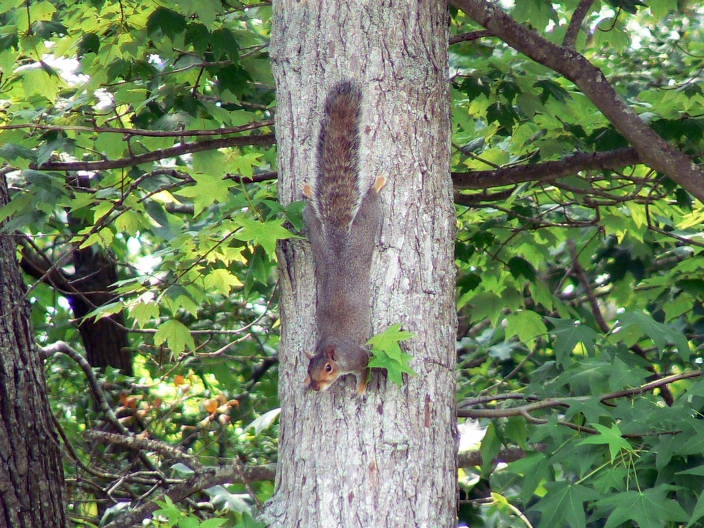
Photo: Laura Perlick / USFWS, “Eastern gray squirrel on tree”. Public domain. Converted to WebP without cropping. Illustrative wildlife photograph; no agency or product endorsement is implied.
More perspectives →As an Amazon Associate I earn from qualifying purchases.